How to Verify a Lymphatic Therapist's Credentials
"Lymphatic drainage" is advertised in medical, wellness, spa, and postoperative settings, but practitioners using that phrase may have very different levels of education.
Patients seeking care for lymphedema, lipedema, cancer-related swelling, postoperative swelling, chronic venous or lymphatic conditions, pregnancy-related swelling, or other medically complicated edema need more than a marketing title. They should be able to determine whether a practitioner has the education, professional license, clinical scope, and referral relationships appropriate for their individual condition. This guide explains how to verify those qualifications before beginning treatment.
Why the Exact Credential Matters
Manual Lymph Drainage is one component of lymphatic care. It is not a substitute for medical assessment, differential screening, compression expertise, skin care, exercise, patient education, treatment planning, or coordination with physicians and other healthcare professionals when those services are needed.
A practitioner may be trained to perform an MLD sequence without having comprehensive education in Complete Decongestive Therapy or the clinical management of complex edema. This distinction is particularly important for people with:
- Diagnosed or suspected lymphedema
- Lipedema or lipo-lymphedema
- Cancer-related or cancer-treatment-related swelling
- A history of lymph-node removal or radiation
- Chronic venous insufficiency or phlebolymphedema
- Unexplained, sudden, asymmetric, painful, red, or warm swelling
- Active or recent infection
- A known or suspected blood clot
- Cardiac, kidney, liver, or vascular disease
- Recent surgery, open or healing incisions, drains, seromas, or suspected postoperative complications
- Pregnancy accompanied by new, sudden, severe, or otherwise concerning swelling
- A high-risk pregnancy or a condition requiring clearance from the patient's obstetric clinician
These circumstances may require medical evaluation, precautions, treatment modifications, physician clearance, or referral rather than routine spa-style lymphatic treatment. MLD does not diagnose or cure any of these conditions.
Certified Lymphedema Therapist and CDT Education
A Certified Lymphedema Therapist should have completed comprehensive education in Complete Decongestive Therapy, generally involving at least 135 hours of instruction. Comprehensive CLT/CDT education typically includes:
- Manual Lymph Drainage
- Multilayer compression bandaging
- Medical compression garments and fitting
- Skin and nail care
- Decongestive exercise
- Lymphatic anatomy and physiology
- Assessment and measurement
- Contraindications and precautions
- Treatment planning
- Patient self-management
- Recognition of findings that require medical referral
A CLT credential should be independently verified through the issuing school, an official professional directory, or a certificate that identifies the practitioner, exact program, issuing institution, training hours, and completion date.
What an MLD or MLD-C Credential Establishes
An MLD or MLD-C credential confirms education in Manual Lymph Drainage when it was earned through a legitimate, verifiable training program.
It does not, by itself, confirm comprehensive Complete Decongestive Therapy education or establish that the practitioner is qualified to independently assess and manage diagnosed lymphedema, lipedema with lymphatic involvement, cancer-related lymphedema, phlebolymphedema, or other medically complex swelling.
An MLD-only practitioner should not represent an MLD course as equivalent to full CLT/CDT education. The practitioner must also remain within the scope of their underlying state-issued professional license and should recognize when medical clearance, collaboration, or referral to a qualified lymphedema clinician is needed. An MLD-only certificate is not, by itself, proof of comprehensive qualification for independent management of complex medical edema.
"Vodder-Trained" Is Not a Complete Credential Description
"Vodder-trained" is not one standardized level of qualification. Dr. Vodder education includes distinct levels, and patients should ask exactly which level the practitioner completed:
- Level 3 / full CDT — comprehensive lymphedema-therapist education.
- Level 1, Level 2, or Applied MLD — education in MLD, but not equivalent to full CLT/CDT certification.
A massage-school biography, employer profile, social-media biography, or marketing page stating that someone is "trained in the Vodder technique" does not independently verify an official Dr. Vodder School credential. Verification should come from the practitioner's official Dr. Vodder School directory profile, confirmation directly from the school, or a certificate identifying the exact course, level, practitioner, completion date, and issuing institution.
Do not assume that "Vodder-trained" means the practitioner completed Level 3 or is a Certified Lymphedema Therapist. Ask which level was completed, and confirm it independently using the directories below.
A Certificate Is Only as Meaningful as the Education Behind It
The word "certified" is not enough. A visually impressive certificate does not establish the quality, duration, clinical depth, recognition, or legitimacy of the training behind it. Patients should be cautious when a credential comes from:
- An extremely short or weekend-only course presented as comprehensive medical lymphatic training
- An online-only course without supervised practical instruction or competency assessment
- A downloadable or editable certificate template
- A program that does not identify its instructors, curriculum, training hours, prerequisites, or assessment requirements
- A business that cannot independently confirm that the practitioner completed its program
- A certificate using vague terms without naming the exact method or level completed
A legitimate certificate should identify the practitioner, issuing institution, exact course or certification, completion date, and — when applicable — the number of training hours or certification level. A certificate image alone should not be treated as proof if its issuing institution and program cannot be independently confirmed.
If a credential can't be independently confirmed through the school, an official directory, or a complete certificate, treat it as unverified — no matter how professional the certificate looks.
Marketing Language Is Not a Clinical Credential
The following phrases do not, by themselves, establish a recognized CLT, CDT, or MLD qualification:
- Lymphatic specialist
- Lymphatic drainage specialist
- Certified lymphatic therapist
- Lymphatic drainage certified
- Postoperative lymphatic massage
- Post-op drainage
- Brazilian lymphatic drainage
- Brazilian MLD
- Colombian lymphatic massage
- Body-sculpting lymphatic massage
- Detox massage
- Vodder-trained
- Offers MLD
- Lymphatic practitioner
Some of these terms may describe a service style or marketing concept rather than a standardized medical credential — not every practitioner using one is unqualified. The terminology alone is not proof of education or clinical qualification. Ask for the exact course, school, training level, number of hours, completion date, professional license, and an independent way to verify the claimed education.
What Manual Lymph Drainage Is — and Is Not
Manual Lymph Drainage is a specialized, gentle technique using light, rhythmic skin-stretching movements intended to support movement of lymphatic fluid through appropriate pathways.
MLD is not deep-tissue massage. Proper MLD should not rely on forceful kneading, aggressive pressure, bruising, or deliberately painful treatment. Deep or heavy pressure may increase capillary filtration, irritate healing tissue, and potentially aggravate swelling. Patients should speak up and ask the practitioner to stop if a treatment is painful, causes bruising, creates new or increasing swelling, produces unusual warmth or redness, or causes other concerning symptoms.
MLD Is Not
- A weight-loss treatment
- A method of permanently removing fat
- A substitute for liposuction
- A guaranteed body-sculpting treatment
- A "detox" that removes unspecified toxins
- A technique for forcing fluid out through open incision sites
- A substitute for medical evaluation of unexplained swelling
- A cure for lymphedema, lipedema, cancer, fibrosis, or postoperative complications
Temporary changes in swelling, bloating, or body measurements should not be represented as fat loss or permanent body contouring.
Drainage of fluid through an open incision is not Manual Lymph Drainage. A practitioner should not intentionally reopen an incision, insert an instrument into it, or force fluid through it. Incisions, drains, seromas, suspected infections, wound separation, unusual drainage, or other postoperative concerns require adherence to the surgeon's instructions and, when appropriate, prompt medical evaluation. This does not mean all postoperative touch is prohibited — timing and precautions depend on the procedure, wound status, surgeon instructions, and the practitioner's qualifications. MLD should not be performed directly over an incision until the treating medical team has determined that doing so is appropriate.
Lipedema Requires More Than a Body-Contouring Claim
Lipedema is a chronic condition involving disproportionate fatty tissue, pain or tenderness, and other connective-tissue and vascular features. It is not simply obesity, ordinary fluid retention, or a cosmetic contour problem.
MLD may be one part of an individualized conservative or postoperative plan for some people with lipedema, particularly when swelling or lymphatic impairment is also present. It does not remove lipedema fat, produce weight loss, or cure the condition.
Appropriate care may also involve medical evaluation, properly selected compression, exercise or movement, skin care, pain and mobility considerations, vascular or lymphatic assessment, and coordination with other qualified clinicians.
Lipedema Foundation — lipedema.org →Pregnancy-Related Swelling Requires Appropriate Screening
Ordinary pregnancy-related swelling and swelling caused by a medical complication are not the same. New, sudden, severe, one-sided, painful, red, or warm swelling — or swelling accompanied by headache, visual changes, shortness of breath, chest pain, elevated blood pressure, or feeling acutely unwell — requires prompt medical assessment.
A patient with a high-risk pregnancy or concerning symptoms should obtain guidance or clearance from the obstetric medical team before receiving MLD or other massage-based treatment.
When treatment is appropriate, it should be provided by a licensed practitioner who has suitable education in pregnancy-related precautions, positioning, clot risk, contraindications, and the patient's individual medical circumstances. Not all pregnancy is a contraindication — and MLD does not prevent or treat preeclampsia, blood clots, or other pregnancy complications.
Verify the Underlying Professional License
A lymphatic-course certificate and a state-issued professional license are not the same thing. Patients should verify both. A state license identifies the practitioner's legally regulated profession and scope — it does not independently confirm CLT, CDT, Vodder, or MLD education. Conversely, a private lymphatic certificate does not expand a practitioner's legal scope of practice.
In Virginia, an esthetician and a master esthetician are not the same license. Not every Virginia esthetician is authorized to provide medical MLD, and scope varies by license type and service.
Before receiving treatment, verify the practitioner's current state license and confirm that the service being offered falls within that license's scope. If the treatment involves a diagnosed medical condition, medically complicated edema, cancer-related care, postoperative complications, or another condition requiring clinical judgment, ask whether the practitioner's license, education, and referral relationships are appropriate for that care.
What Patients Should Ask For
Anyone publicly advertising a CLT, CDT, MLD, MLD-C, Vodder, or similar credential should make the claim independently verifiable. Patients should request:
- The practitioner's full name
- Underlying professional license and license number
- Issuing school or institution
- Exact course or certification title
- Training level
- Number of training hours
- Completion date
- Certificate number, if one was issued
- A direct link to an official directory profile or verification from the school
Until these details can be independently confirmed, the credential should be described as unverified.
Where to Verify a Credential
National Lymphedema Network — NLN
Lymphedema Therapy Directory
lymphnet.org/lymphedema-therapy-directory →Patient Support: patientsupport@lymphnet.org · 800-541-3259
Academy of Lymphatic Studies — ACOLS
Therapist Directory
acols.com/find-therapist →Telephone: 772-589-3355
Dr. Vodder School
Two separate directories — check which one lists the practitioner:
Full Lymphedema Therapist Directory → Applied MLD Directory →Email: info@vodderschool.com · 1-800-522-9862
Norton School of Lymphatic Therapy
Therapist Referrals
nortonschool.com/therapist-referrals →Telephone: 866-808-2249
Lymphology Association of North America — LANA
LANA verifies the additional CLT-LANA board credential. Not every Certified Lymphedema Therapist holds CLT-LANA — it is a separate, optional board certification.
clt-lana.org/therapists →Telephone: 773-756-8971
Other recognized training institutions include Brennan School of Innovative Lymphatic Studies, Casley-Smith programs, International Lymphedema & Wound Training Institute, Monarch Continuing Education, and Pacific Therapy Education. Credentials from these institutions should be verified directly with the issuing institution.
Verify Eva Tutic's Credentials
Eva Tutic, CLT, CPST, LMT
Eva Tutic, CLT, CPST, LMT, completed the Academy of Lymphatic Studies' 135-hour certification program in Manual Lymph Drainage using the Vodder Technique and Complete Decongestive Therapy on June 9, 2024. She subsequently completed an additional 28-hour advanced course in the management of post-plastic-surgery procedures on August 18, 2024. Her professional license and specialized lymphatic training can be independently verified through the certificates, professional directories, and public license record provided here.
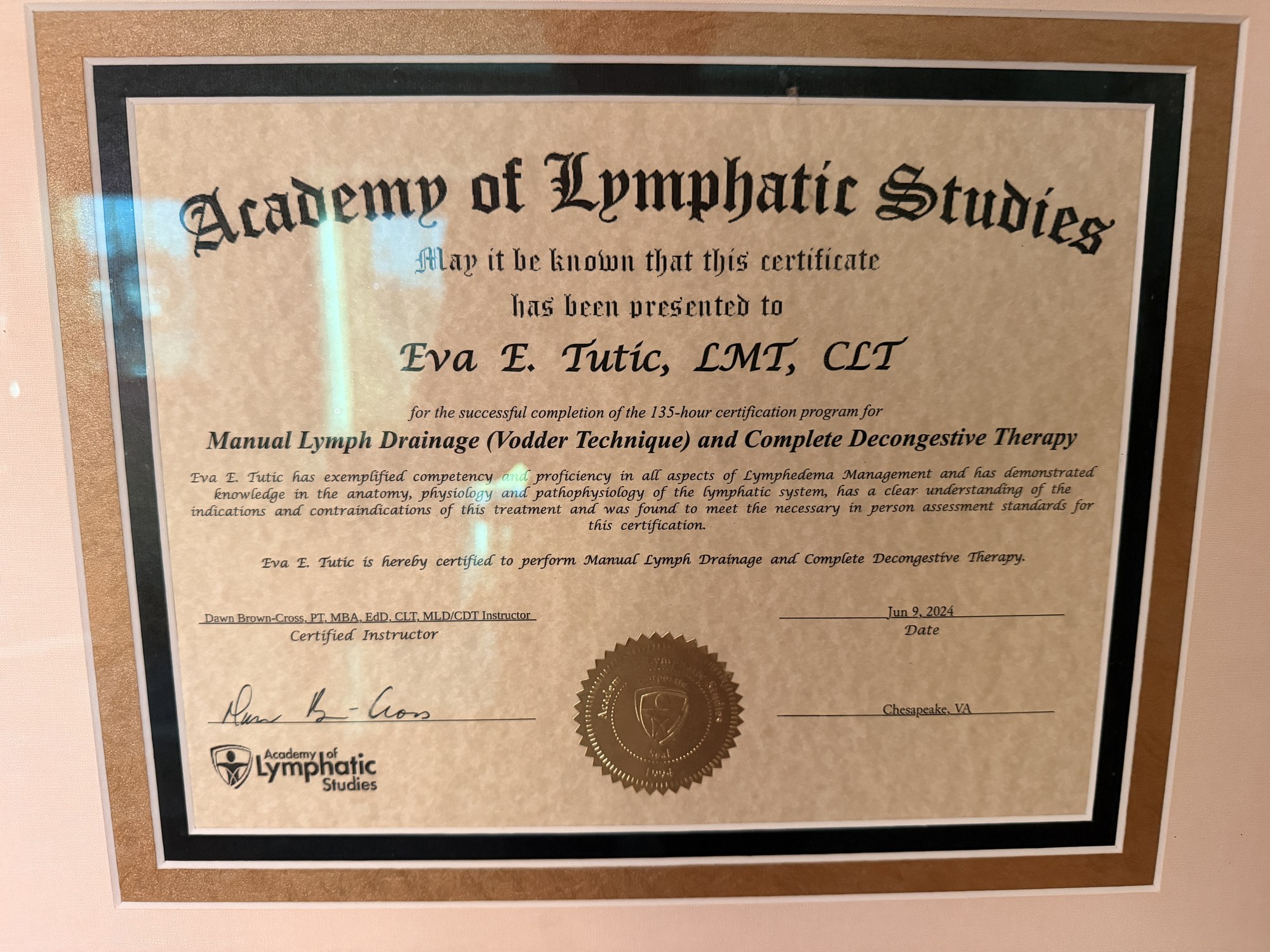
135-Hour CLT/CDT Certification
Academy of Lymphatic Studies · Completed June 9, 2024
View full-size certificate →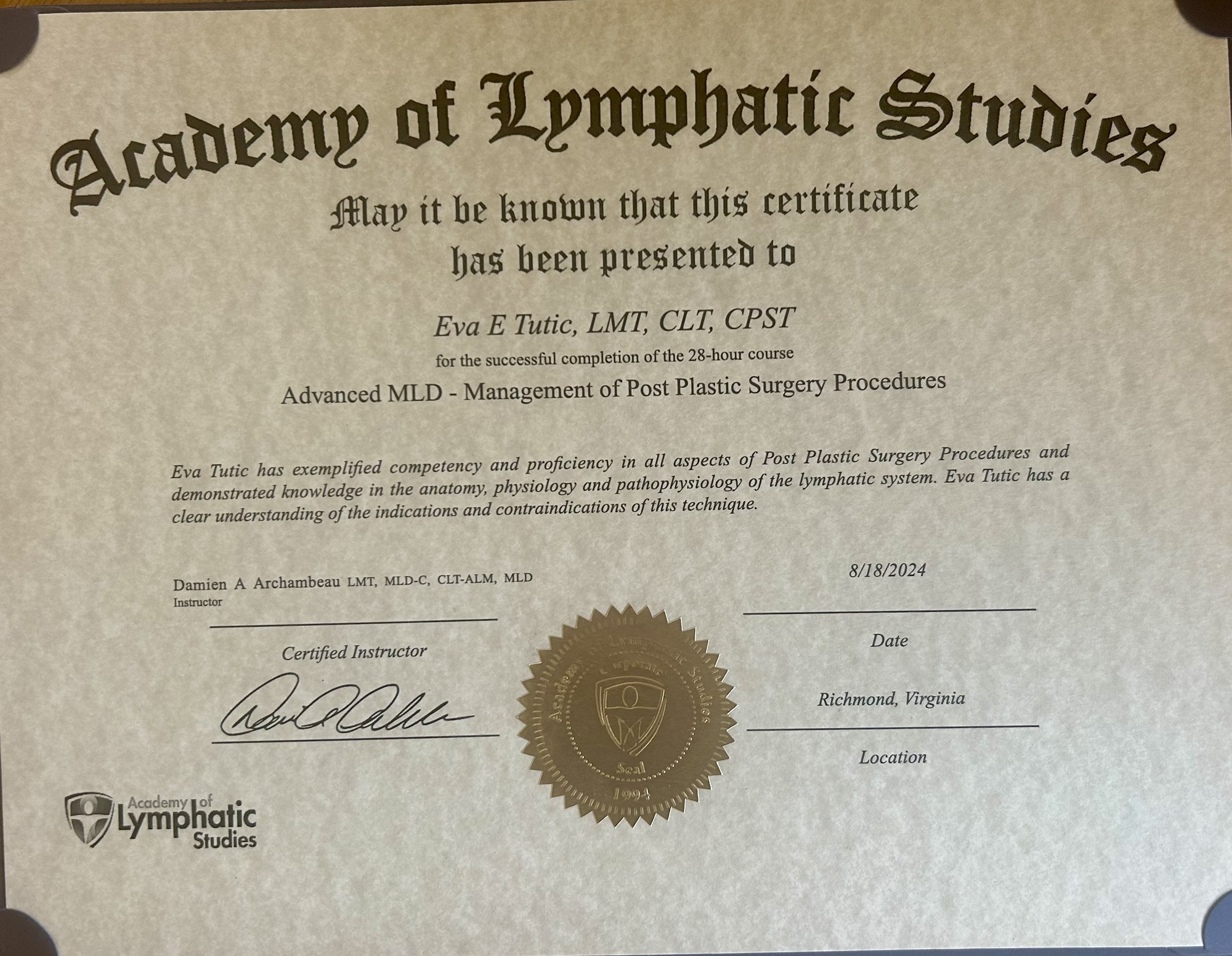
Advanced Post-Plastic-Surgery Training
Academy of Lymphatic Studies · 28 hours · Completed August 18, 2024
View full-size certificate →Five Ways to Independently Verify
- View Eva's 135-hour CLT/CDT certificate.
- View Eva's 28-hour advanced post-plastic-surgery certificate.
- Verify Eva Tutic in the ACOLS Therapist Directory.
- Find Eva Tutic in the NLN Lymphedema Therapy Directory.
- Verify Eva Tutic's Virginia Professional License.
- CLT — Certified Lymphedema Therapist: Academy of Lymphatic Studies, 135-hour program, completed June 9, 2024.
- CPST — Certified Plastic Surgery Therapist: Academy of Lymphatic Studies, 28-hour advanced post-plastic-surgery course, completed August 18, 2024.
- LMT — Licensed Massage Therapist: Virginia state license — verify directly via the license record linked above.
Eva Tutic, CLT, CPST, LMT, is listed in the National Lymphedema Network Lymphedema Therapy Directory.
Meet Eva Tutic →Professional Organizations & Educational Resources
National Lymphedema Network
lymphnet.org →LE&RN: Find a Qualified Lymphedema Therapist
LE&RN provides patient education about what to look for in a qualified lymphedema therapist, including comprehensive 135-hour CLT training. Its guidance identifies the Academy of Lymphatic Studies among the qualified training schools and directs patients to professional therapist directories, including ACOLS and the National Lymphedema Network.
Read LE&RN's Guidance for Finding a Qualified Therapist →Lipedema Foundation
lipedema.org →TheraFlow Health is not a member, directory provider, partner, representative, affiliate, or endorsed practitioner of these organizations unless stated otherwise. They are shared here as independent, recognized education and research resources for patients. LE&RN, NLN, and the Lipedema Foundation have not certified, approved, or endorsed Eva Tutic or TheraFlow Health.
This guide is educational and does not diagnose a condition or determine which treatment is appropriate for an individual patient. New, unexplained, rapidly increasing, painful, red, warm, or one-sided swelling — and symptoms such as chest pain, shortness of breath, fever, or feeling acutely unwell — require prompt medical evaluation.